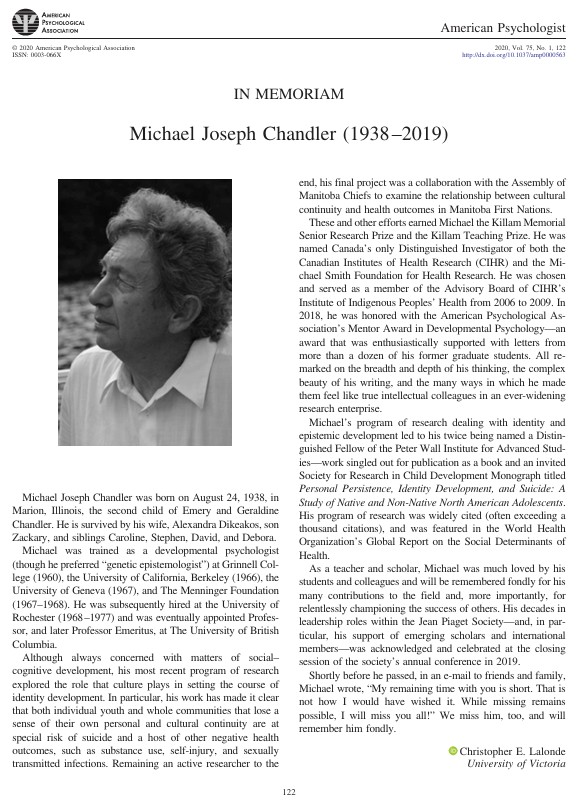
OBITUARY: Michael Chandler (24 August 1938 – 28 January 2019) With great sadness we report the loss of our friend and colleague Michael Chandler. Michael is survived by his wife Alexandra and son Zack and siblings: Caroline, Stephen, David, and Debora, by a scattering...
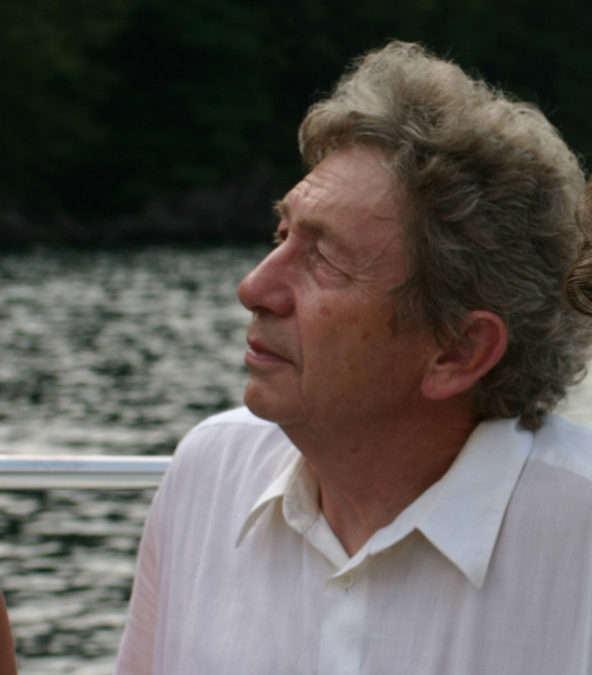
Michael Joseph Chandler was born on August 24, 1938, in Marion, Illinois, the second child of Emery and Geraldine Chandler. He is survived by his wife, Alexandra Dikeakos, son Zackary, and siblings Caroline, Stephen, David, and Debora. Michael was trained as a developmental psychologist (though he preferred “genetic epistemologist”) at Grinnell College (1960), the University of California, Berkeley (1966), the
University of Geneva (1967), and The Menninger Foundation (1967–1968). He was subsequently hired at the University of Rochester (1968–1977) and was eventually appointed Professor, and later Professor Emeritus, at The University of British Columbia.
Although always concerned with matters of social cognitive development, his most recent program of research explored the role that culture plays in setting the course of identity development. In particular, his work has made it clear that both individual youth and whole communities that lose a sense of their own personal and cultural continuity are at special risk of suicide and a host of other negative health outcomes, such as substance use, self-injury, and sexually transmitted infections. Remaining an active researcher to the end, his final project was a collaboration with the Assembly of Manitoba Chiefs to examine the relationship between cultural continuity and health outcomes in Manitoba First Nations.
These and other efforts earned Michael the Killam Memorial Senior Research Prize and the Killam Teaching Prize. He was named Canada’s only Distinguished Investigator of both the Canadian Institutes of Health Research (CIHR) and the Michael Smith Foundation for Health Research. He was chosen and served as a member of the Advisory Board of CIHR’s Institute of Indigenous Peoples’ Health from 2006 to 2009. In 2018, he was honored with the American Psychological Association’s Mentor Award in Developmental Psychology—an award that was enthusiastically supported with letters from more than a dozen of his former graduate students. All remarked on the breadth and depth of his thinking, the complex beauty of his writing, and the many ways in which he made them feel like true intellectual colleagues in an ever-widening research enterprise.
Michael’s program of research dealing with identity and epistemic development led to his twice being named a Distinguished Fellow of the Peter Wall Institute for Advanced Studies—work singled out for publication as a book and an invited Society for Research in Child Development Monograph titled Personal Persistence, Identity Development, and Suicide: A Study of Native and Non-Native North American Adolescents. His program of research was widely cited (often exceeding a thousand citations), and was featured in the World Health Organization’s Global Report on the Social Determinants of Health.
As a teacher and scholar, Michael was much loved by his students and colleagues and will be remembered fondly for his many contributions to the field and, more importantly, for relentlessly championing the success of others. His decades in leadership roles within the Jean Piaget Society—and, in particular, his support of emerging scholars and international members—was acknowledged and celebrated at the closing session of the society’s annual conference in 2019.
Shortly before he passed, in an e-mail to friends and family, Michael wrote, “My remaining time with you is short. That is not how I would have wished it. While missing remains possible, I will miss you all!” We miss him, too, and will remember him fondly.
Written by Christopher E. Lalonde in American Psychological Associations (2020)