
How Ideas Travel - Curriculum Ideas

Colette Daiute

Nancy Budwig
Co-Conveners: Colette Daiute & Nancy Budwig
Editor: Bridget Woods
Music: Jack J. Wright
Art: Gooloc/Jamie-Lee Barden
Contact: howideastravel@gmail.com
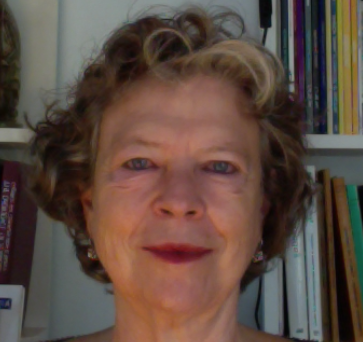
Cintia Rodríguez
Episode 2: Collaboration with Passion
Cintia Rodríguez is a professor of Developmental Psychology at the University of Autónoma in Madrid, Spain. She studied in the School of Geneva where she had the opportunity to work as an assistant on Bärbel Inhelder’s team. Cintia’s experience in the Groupe Stratégies et résolution de problems (Strategies and problem solving group) provided the chance to work on microgenetic analysis with Madelson Saada-Robert, greatly influencing her research.
Professor Rodriguez has collaborated with C. Moro in Geneva, and the two are leading figures in understanding the pragmatics of the object in early socio-cognitive development. Recently, Dr. Rodriguez has been studying the early manifestations of executive functions in everyday contexts during the first year of life and in school settings, examining the challenges give themselves as active agents in their own development and the supportive actions by teachers.
An international scholar, Rodriguez spent two sabbatical years abroad, in the 1997-1998 academic year at Clark University, Worcester, MA. USA, and in 2004-2005 at Portsmouth University (UK). She also has had several stays in South America: Mexico, Brazil, Chili, Colombia and Argentina, as well as traveling regularly throughout Europe. Cintia Rodriguez has published extensively in Spanish, French, and English. She has authored or co-authored 5 books and edited volumes, multiple book chapters, and journal articles in prestigious outlets such as Cognitive Development, Human Development, and New Ideas in Psychology.
https://deteduca.com/mesmerize/c-rodriguez/
SUGGESTED READINGS:
Rodríguez, C., Basilio, M., Cárdenas, K., Cavalcante, S., Moreno-Núñez, A., Palacios, P., & Yuste, N. (2018). Object pragmatics: Culture and communication – the bases for early cognitive development. In A. Rosa & J. Valsiner (Eds.), The Cambridge handbook of socio-cultural psychology (2.a ed., pp. 223-244). New York: Cambridge University Press. doi:10.1017/9781316662229.013.
Rodríguez, C. & Moreno-Llanos, I. (2020). A pragmatic turn in the study of early executive functions by object use and gestures. A case study from 8 to 17 months of age at a nursery school. Integrative Psychological and Behavioral Science.
Rodríguez, C., Estrada, L., Moreno-Llanos, I., & de los Reyes, J. L. (2017). Executive Functions and educational actions in an Infant School: Private uses and gestures at the end of the first year. Estudios de Psicología, 38(2), 385-423. https://doi.org/10.1080/02109395.2017.1305061
Video and related article for curricular exercise: (in curricular assignments folder)
Rodríguez, C. and Palacios, P. (2007). Do private gestures have a self-regulatory function? A Case Study. Infant Behavior and Development, 30, 180-194. https://doi.org/10.1016/j.infbeh.2007.02.010
CURRICULUM IDEAS:
A. Listen to the podcast
- Professor Rodriquez reflects on her multi-decade career that took her from Madrid to Geneva and back to Madrid. Which of her reflections about her experiences stood out to you? Why?
- How did Rodriguez build upon the ideas of others in Geneva and how did it distinguish itself from that tradition? In what ways has your work built upon others?
- What question would you ask Professor Rodriquez if you had the opportunity?
- Does her advice resonate? What does it make you think about as you advance in your career?
- Read one or two articles provided by the interviewee.
- Read one paper on the pragmatics of objects and one on early learning.
- What commonalities and what differences do you see in these articles
Excertps from How Ideas Travel Podcast: Episode Two
Cintia Rodríguez
A Rich Atmosphere
Cintia Rodríguez
Curious Mentorship
Cintia Rodríguez
Passionate Collaborations

0 Comments